WATA-Graded NES Games — Authentication Risk, Tampering Exposure, and Costly Slab Misclassification Guide
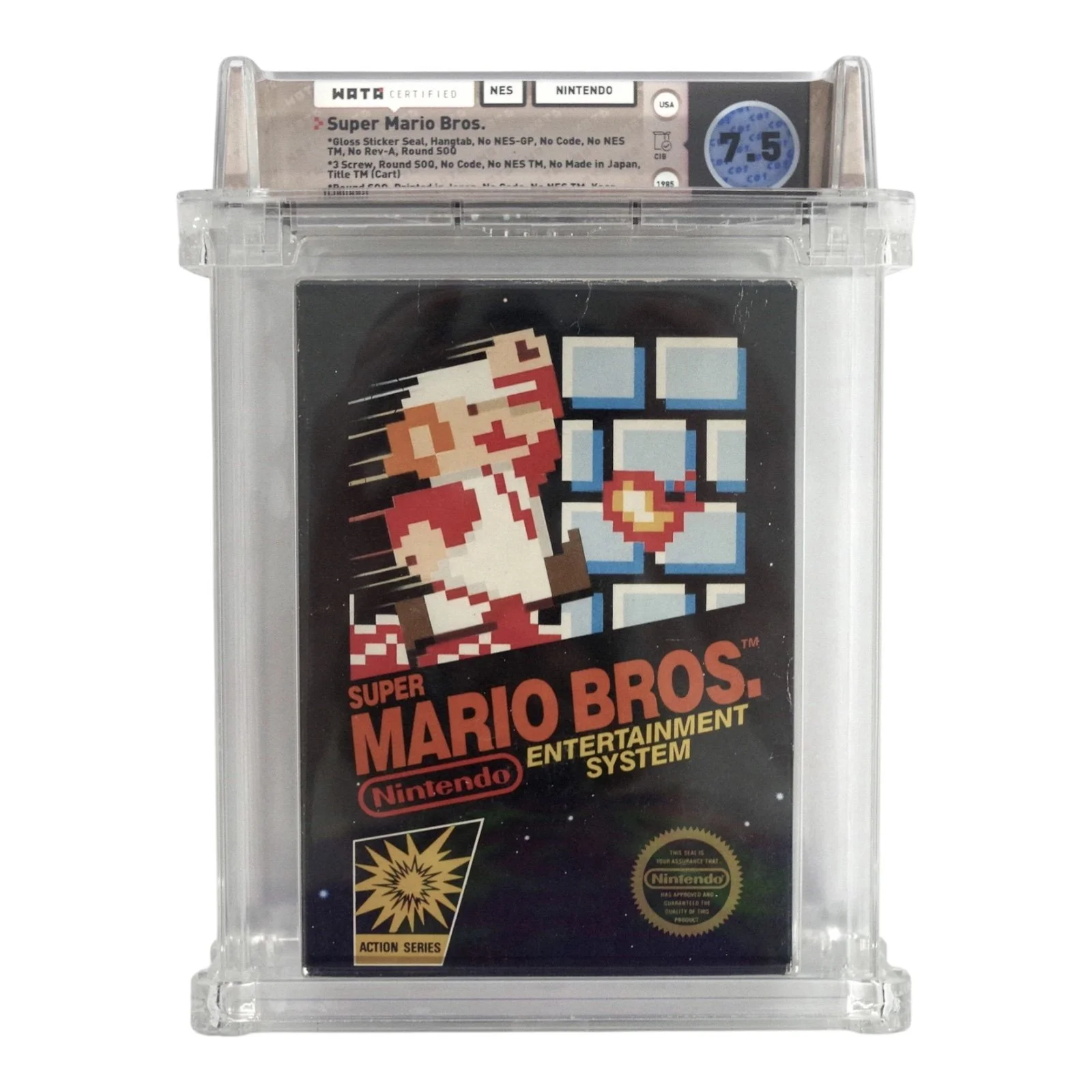
Super Mario Bros. NES Gloss Sticker edition graded WATA 7.5 CIB — seal integrity, print variant classification, slab structure, and internal configuration exposure must align before resale or auction positioning.
Introduction — The False Confidence Problem
A WATA slab creates immediate confidence.
Encapsulation, grading labels, holograms, and numeric condition scores signal legitimacy. Many collectors assume that once a Nintendo Entertainment System game is inside a WATA holder, authenticity and seal integrity are no longer concerns.
That assumption is dangerous.
WATA-graded NES games exist within a layered risk environment: resealed boxes, cartridge swaps, PCB mismatches, insert substitutions, tampered slabs, and market reclassification exposure. Encapsulation documents condition at the time of grading. It does not eliminate authentication complexity.
DJR Authentication specializes in professional evaluation of WATA-graded NES games and related sealed video game assets.
Collectors often equate grading with verification. In reality, seal integrity, packaging authenticity, and internal configuration risk must be evaluated before market positioning decisions are made.
In this market, assumptions become expensive quickly.
Where Most Collectors Go Wrong
Treating a WATA slab as a substitute for authentication review
Assuming shrinkwrap inside a holder was never disturbed
Ignoring cartridge or PCB swap risk
Overlooking box flap stress or reseal indicators
Confusing grade with authenticity
Accepting hologram presence as tamper-proof evidence
Relying solely on past auction results for valuation confidence
A high numeric grade does not eliminate underlying structural risk. It reflects observed condition at submission — not future market scrutiny.
Why This Category Carries Elevated Risk
Several factors elevate risk in WATA-graded NES games.
First, sealed NES games are among the most counterfeited and resealed categories in retro collecting. High-value titles attract sophisticated manipulation.
Second, shrinkwrap patterns, H-seams, fold integrity, and venting characteristics vary by production period. Misinterpretation can lead to incorrect assumptions about factory seal status.
Third, slab tampering — while uncommon — remains a documented concern in the broader grading ecosystem. Case construction and label consistency matter.
Fourth, internal configuration risk exists. Cartridge swaps, PCB mismatches, or incomplete inserts may not be immediately apparent without structured evaluation.
Fifth, auction houses and high-end buyers increasingly scrutinize sealed game authenticity beyond grading labels.
In this category, a single misidentified item can represent thousands or even tens of thousands of dollars in financial exposure.
Encapsulation reduces some variables. It does not eliminate complexity.
This cannot be confirmed casually.
What Must Be Verified First
Before authenticity or market positioning can be established with confidence, several checkpoints must align:
Slab construction consistency and label alignment
Seal integrity consistent with documented NES production patterns
Box structure and flap stress evaluation
Insert completeness and configuration expectations
Cartridge and PCB authenticity exposure
Auction-level scrutiny risk assessment
These variables must align before authenticity or value can be established with confidence.
Verification is layered. Each variable informs classification.
Path 1 — Professional Review
Professional evaluation is appropriate:
Before acquiring high-value sealed NES games
Prior to auction consignment
When slab tampering concerns exist
For insurance or estate documentation
When seal status or internal configuration risk is unclear
Start with a professional evaluation.
Early evaluation prevents costly mistakes and protects your position before a transaction, submission, or sale.
Most clients begin with an Online Fast Opinion to determine authenticity risk and whether further documentation is warranted.
In-person consultations are available by appointment in Charleston, SC.
Encapsulation should not replace verification when significant capital is involved.
Path 2 — Complete Education System
Collectors who want a structured framework before professional review can explore the WATA-Graded NES Games Authentication & Ownership System.
The system addresses:
Slab structure and tamper exposure awareness
Seal interpretation and reseal risk
Cartridge and PCB consistency concerns
Grading failure scenarios
Long-term ownership and resale positioning strategy
Collectors who want a structured framework before seeking professional review can explore the DJR Expert Guide Library.
Education improves awareness. Structured evaluation protects capital.
Before You Act
Most costly mistakes occur before professional evaluation.
Confidence should follow verification, not precede it.
Early assumptions create irreversible financial exposure in high-value sealed game markets.
Professional review preserves options, protects resale credibility, and reduces reclassification risk.
With WATA-graded NES games, the most important decision happens before acquisition, submission, or auction.