The 1740 Matthew Loft Culpeper Microscope — When Early Scientific Instruments Create False Security
The Situation
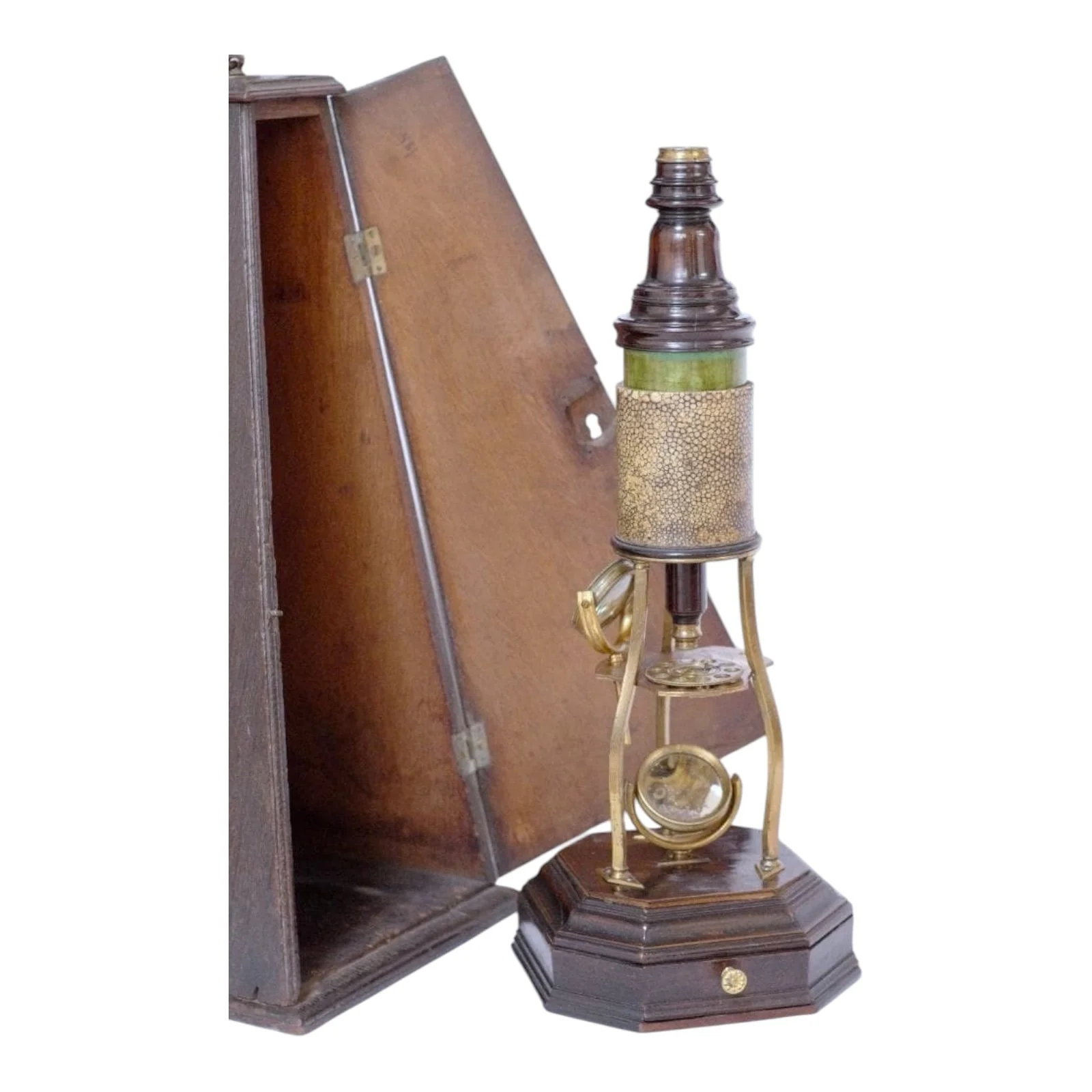
An early-Georgian Culpeper-type microscope surfaces, attributed to Matthew Loft, a London craftsman active in the first half of the 18th century. The instrument presents with classic brass tripod construction, period-appropriate proportions, and an appearance consistent with early scientific tools produced around 1740. Claims of rarity, notable makership, and exceptional preservation quickly shape expectations—often before authorship, originality, and historical integrity are fully understood.
Where Early Decisions Go Wrong
At this stage, many owners assume that visible age, craftsmanship, and stylistic alignment are sufficient to confirm attribution. Others rely on repeated biographical narratives—apprenticeships, notable commissions, or auction mentions—to shortcut verification. The most common error is treating historical plausibility as proof, particularly in early instruments where components were routinely repaired, replaced, or adapted across generations.
Why This Category Carries Unique Risk
Early scientific instruments occupy a category where authenticity is rarely absolute. Microscopes were functional tools, not static display objects. Optics, fittings, and mounts were serviced as technology evolved, and cases were altered to extend use. In Culpeper-type microscopes, correct form alone does not establish maker attribution, period purity, or originality of components. Once assumptions are publicly attached to a named maker or date, correcting course becomes difficult and credibility can erode quickly.
What Must Be Determined First
Before any action, professionals pause to consider:
Whether construction and materials align with the claimed production period
Whether components reflect consistent manufacture or later intervention
Whether maker attribution is supported beyond stylistic similarity
Whether professional review would materially affect classification or confidence
Whether restraint preserves flexibility better than early positioning
These questions must be identified before assumptions are treated as conclusions.
The Decision Fork
Path 1 — Professional Review
When early scientific instruments involve maker attribution, museum-level representation, or institutional interest, a first-stage professional review is the safest place to begin. Most clients start with an Online Fast Opinion—a first-stage professional review—to determine whether further appraisal or authentication is warranted, and whether escalation adds clarity or unnecessary exposure. This step separates historical narrative from verifiable evidence before irreversible decisions are made.
Path 2 — Preliminary Self-Education
For those seeking context before engaging professional services, DJR Expert Guide Series, Vol. 401 — How to Authenticate Antique Scientific Instruments (Microscopes, Compasses & Sextants) provides category-specific orientation on how early instruments are evaluated, where composite construction commonly appears, and why correct form does not automatically establish maker attribution or originality. It is designed to reduce early decision risk—not to replace professional review or resolve authorship, period integrity, or market positioning.
Before You Act
In early scientific and medical instrument categories, confidence often arrives before confirmation. The most costly mistakes tend to occur when craftsmanship and historical narrative are mistaken for proof. Disciplined restraint remains the most defensible first decision.
At DJR Authentication, we appraise and authenticate scientific instruments and historic artifacts. Reports include full documentation suitable for insurance, estate planning, resale, and more. Visit djrpro.com to learn more. In-person consultations are available by appointment in Charleston, SC.