Metal Detector Finds That Appear “Obviously Old” Are Where Misidentification Happens Most
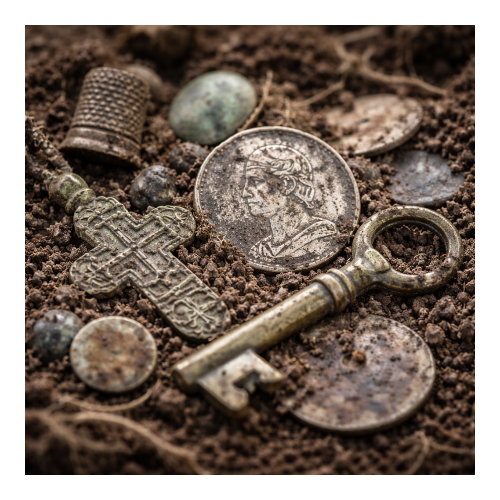
The Situation
Metal detector discoveries often feel self-authenticating. Soil staining, corrosion, irregular surfaces, and apparent age give many finders a sense that the object has already “proven itself.”
That assumption is one of the most common reasons historically insignificant material is misrepresented—or historically important material is damaged, undervalued, or permanently compromised.
Objects recovered from the ground do not age uniformly. Soil chemistry, moisture exposure, and modern burial events can produce convincing surface characteristics that look correct at a glance but are misleading in context.
The risk is not that an object is modern.
The risk is acting as though age alone resolves identification.
Why Ground Recovery Creates False Confidence
Burial alters metal. It does not validate it.
Modern debris, altered reproductions, and intentionally buried replicas frequently display surface characteristics that appear consistent with age. In many cases, those characteristics are the result of environmental exposure rather than historical origin.
Once an item is cleaned, listed, or verbally represented as authentic, reversing that assumption becomes difficult—especially if value, provenance, or third-party interest is involved.
Ground recovery is not a credential.
It is a variable.
Where Most Finds Are Misclassified
Misclassification rarely happens at discovery. It happens during interpretation.
This typically occurs when:
Objects are identified by resemblance rather than construction
Surface corrosion is treated as proof rather than a condition factor
Era is inferred without resolving manufacturing context
Value assumptions are made before identification stabilizes
At that point, momentum replaces analysis.
That is where long-term mistakes originate.
Why Cleaning and Early Handling Lock In Errors
Once material is cleaned, polished, or altered—even unintentionally—critical diagnostic information can be erased. Tool marks, corrosion layering, and soil interaction often carry more identification weight than the visible object itself.
Well-meaning attempts to make an item presentable can eliminate the very evidence required to determine what it actually is.
The danger is not damage alone.
It is deciding what the object represents before the evidence has been evaluated.
When Online Identification Fails Quietly
Crowdsourced identification and forum consensus often feel authoritative, especially when multiple voices agree. In practice, these environments reward surface similarity rather than structured analysis.
Once an interpretation circulates, it hardens. Listings are written. Descriptions are copied. Assumptions compound.
By the time a professional opinion is sought, the question has often shifted from “what is this?” to “why doesn’t this match what I was told?”
That reversal is costly.
Why First-Stage Professional Review Exists
Online Fast Opinion exists specifically for this moment—before decisions become irreversible.
It is a first-stage professional review. Not a shortcut to value and not a replacement for full authentication. Its purpose is to stop momentum before it creates exposure.
For metal detector finds, that first review frequently prevents:
Premature valuation assumptions
Misrepresentation in resale or estate contexts
Irreversible surface alteration
Overconfidence based on visual age alone
Once confidence is manufactured, correction becomes harder than prevention.
Preliminary Self-Education (Secondary)
In higher-risk categories—relics, militaria, early coins, and ground-recovered artifacts—understanding why identification is complex is often more important than forcing an answer.
That is the role of DJR Expert Guide Series, Vol. 443 — Master Guide to Metal Detector Finds: Authentication & Identification
This guide is not designed to help readers self-authenticate. It exists to clarify where misclassification commonly occurs, why ground recovery complicates attribution, and when professional escalation becomes the responsible choice.
Before You Act
Choosing not to review a find is still a decision—one that assumes the risk has already been resolved.
In many cases, it has not even been identified.
If you have recovered an object and are considering cleaning, selling, documenting, or representing it in any formal context, the defensible next step is not interpretation. It is review.
In-person consultations are available by appointment in Charleston, SC.