Japanese Netsuke That “Look Right” Are Where Authentication Fails Most
The Situation
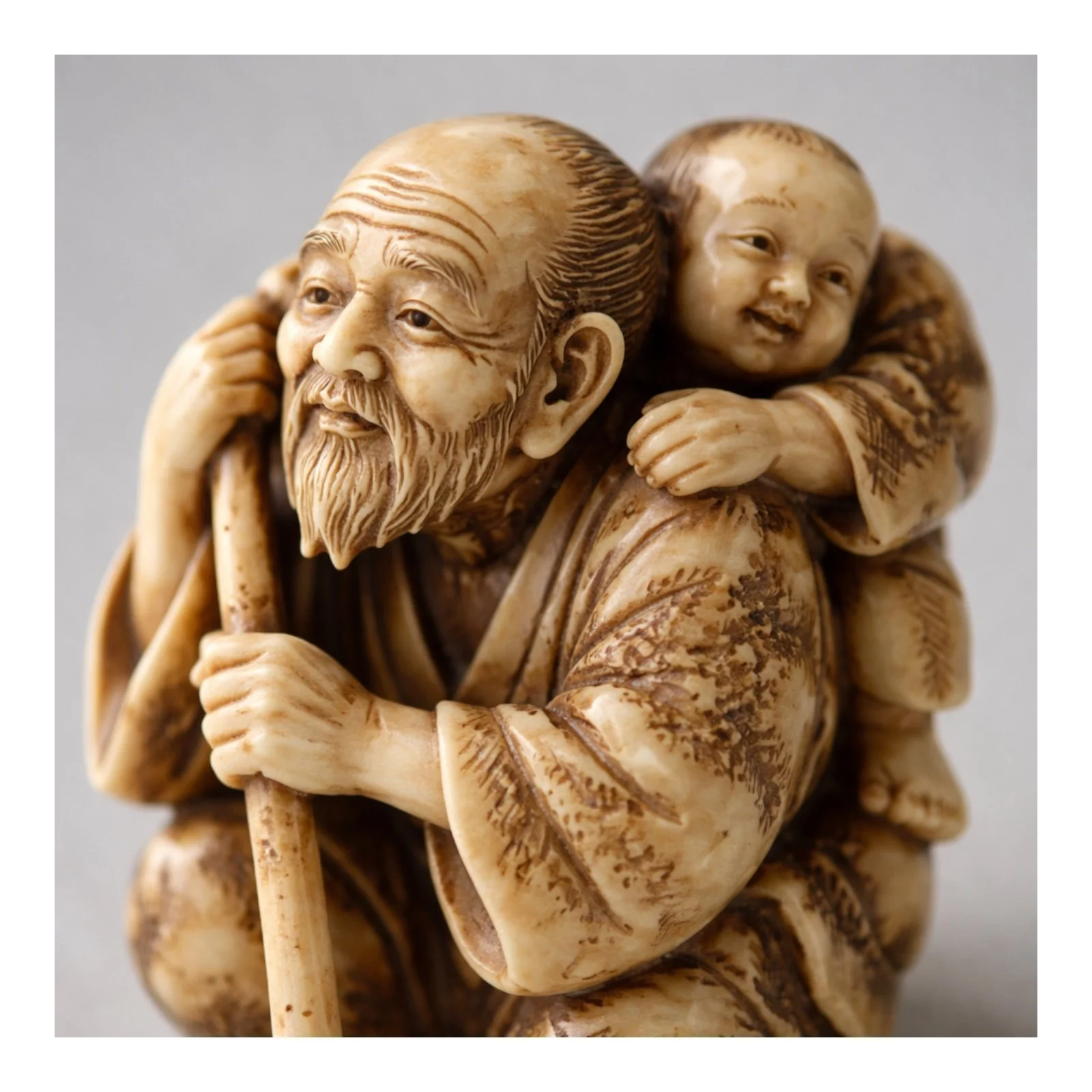
Japanese netsuke and okimono often appear convincing at first glance. Fine detail, aged surfaces, smooth handling wear, and even carved signatures can create immediate confidence—especially for pieces presented as Edo- or Meiji-period works.
That confidence is frequently misplaced.
The global market for netsuke has been saturated for decades with modern reproductions, artificially aged carvings, and skillfully executed tourist-market pieces designed to resemble earlier hand-carved examples. Many are not crude fakes. They are competent objects that fail only when examined correctly.
The risk is not buying something decorative.
The risk is assuming visual correctness resolves authenticity.
Where Early Decisions Go Wrong
Most misclassification occurs before professional review is even considered.
Common early assumptions include:
That surface patina confirms age
That detailed carving implies hand craftsmanship
That a signature establishes authorship
That material appearance confirms ivory, antler, or bone
In reality, none of these elements are decisive in isolation.
Once a piece is verbally described, listed, cleaned, or positioned as authentic, reversing course becomes difficult—especially if value, inheritance, or resale is involved.
Why Netsuke Carry Disproportionate Risk
Netsuke occupy a uniquely vulnerable category.
They are small, tactile objects where wear can be simulated, patina can be induced, and carving skill alone does not establish period. Modern tools and casting methods can reproduce surface detail convincingly while failing deeper structural tests that are not visible without expertise.
Unlike paintings or large sculptures, netsuke are often evaluated informally—passed hand to hand, sold online, or inherited without documentation. This creates a false sense of safety that does not exist in higher-regulated categories.
Authenticity here is technical, not intuitive.
What Must Be Determined First
Before any interpretation hardens into certainty, professionals pause to determine:
Whether the material is correct and legally consistent
Whether carving depth, undercuts, and tool marks reflect hand work
Whether wear patterns align with function or display
Whether patina developed naturally or was induced
Whether signatures are period-correct or later additions
These questions must be resolved before confidence becomes exposure.
The Decision Fork
Path 1 — Professional Review
When netsuke or okimono involve potential ivory, signed attribution, estate value, or resale intent, a first-stage professional review is the safest place to begin.
Most clients start with an Online Fast Opinion—a structured professional checkpoint designed to determine whether escalation is warranted and whether assumptions should be paused before irreversible steps are taken.
In-person consultations are available by appointment in Charleston, SC.
Path 2 — Preliminary Self-Education
For those seeking context before engaging professional services, DJR Expert Guide Series, Vol. 253 — Authentication of Japanese Netsuke and Okimono provides a professional framework for understanding why these objects are frequently misidentified and where modern reproductions most often pass undetected.
The guide explains how materials, carving technique, patina, wear, and signatures are evaluated—and why visual familiarity alone is unreliable.
It is designed to reduce early decision risk, not to replace professional review or establish authenticity.
Before You Act
In netsuke and okimono, confidence often forms faster than clarity.
The most costly mistakes occur when appearance is treated as proof and decisions are made before technical review stabilizes identification.
Restraint is not hesitation.
It is preservation of options.