Yu-Gi-Oh! Blue-Eyes White Dragon LOB-001 Authentication Guide — Costly Misidentification and Hidden Grading Risk
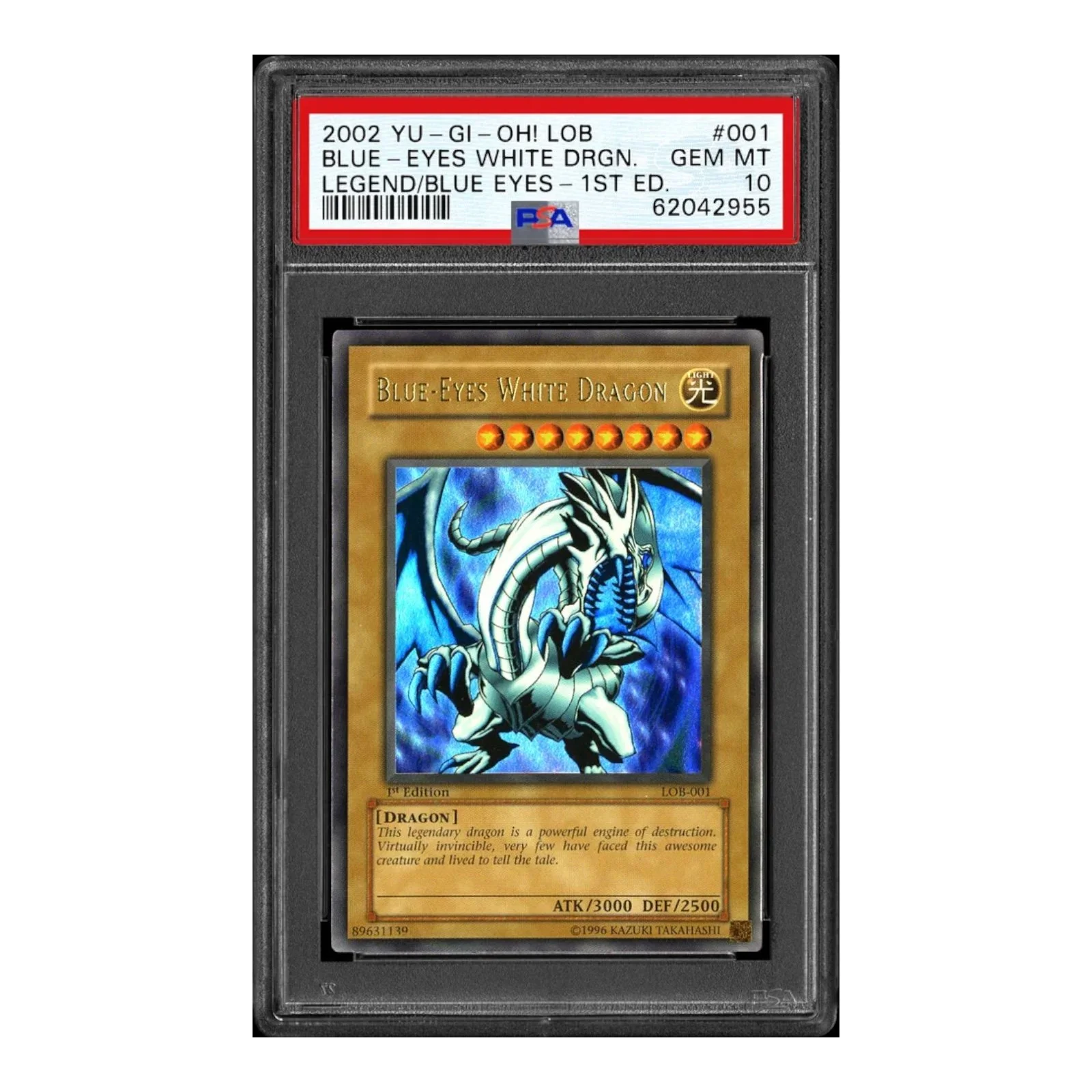
A high-grade PSA 10 Yu-Gi-Oh! Blue-Eyes White Dragon LOB-001 1st Edition
Introduction — The False Confidence Problem
The Yu-Gi-Oh! Blue-Eyes White Dragon LOB-001 is one of the most recognized trading cards in modern collectibles. Its artwork is iconic. Its name is familiar even outside the hobby. And because it is so well known, many collectors assume it is easy to identify and evaluate.
That assumption is where problems begin.
Familiarity creates a dangerous form of confidence. The card “looks right.” The foil shines. The label says 1st Edition. A prior owner claims it was pulled from a pack years ago. Before any structured verification occurs, a conclusion has already formed.
DJR Authentication specializes in professional evaluation of high-value Yu-Gi-Oh! Blue-Eyes White Dragon LOB-001 cards and related collectible assets.
In reality, this single card exists across multiple printings, reprints, anniversary editions, altered versions, and high-end proxies. Subtle production differences matter. Misclassification between LOB and SDK versions is common. Even experienced collectors regularly confuse Unlimited with 1st Edition, or modern commemorative releases with original-era production.
In this market, assumptions become expensive quickly.
Where Most Collectors Go Wrong
Relying on overall appearance rather than verified production characteristics
Treating grading encapsulation as automatic authentication certainty
Assuming 1st Edition labeling alone confirms original LOB status
Confusing SDK Blue-Eyes versions with LOB printings
Trusting seller claims, prior sales history, or anecdotal provenance
Assuming rarity automatically implies authenticity
Believing surface wear indicates age rather than artificial aging or manipulation
These errors are not caused by carelessness. They are caused by overconfidence combined with complexity.
The Blue-Eyes White Dragon LOB-001 is not a simple “spot the fake” scenario. It is a layered production, edition, and classification problem.
Why This Category Carries Elevated Risk
Several factors elevate risk in this specific card category.
First, multiple legitimate print variations exist, each with distinct production characteristics. These differences are subtle and often misunderstood.
Second, high-end proxies and sophisticated reproductions have improved dramatically. Some use convincing materials and replicate visual traits closely enough to pass casual inspection.
Third, altered cards using genuine stock or modified editions create hybrid risks. A card may be partially authentic yet misrepresented in classification.
Fourth, grading does not eliminate authentication exposure. Cards can fail grading for print inconsistencies, surface anomalies, or classification errors. Submission fees, time delays, and resale positioning are all affected.
In this category, a single misidentified item can represent thousands or even tens of thousands of dollars in financial exposure.
The combination of strong market demand, brand recognition, and layered production differences creates a high-risk environment. Casual visual inspection is not sufficient. Even well-intentioned collectors can misjudge edition, authenticity, or grading viability.
This cannot be confirmed casually.
What Must Be Verified First
Before authenticity or value can be established with confidence, structured checkpoints must align:
Card stock consistency relative to known production standards
Foil behavior and holographic alignment within expected manufacturing parameters
Edition accuracy including stamp, print-run classification, and release context
Differentiation between LOB and SDK production characteristics
Evidence of trimming, surface alteration, or structural modification
Exposure to grading rejection due to misclassification or production anomalies
These variables must align before authenticity or value can be established with confidence.
Without disciplined verification, collectors risk misidentifying print runs, misunderstanding grading potential, or overestimating market positioning.
Path 1 — Professional Review
Before buying or selling a Blue-Eyes White Dragon LOB-001, evaluation is appropriate whenever financial exposure is meaningful.
It is especially important:
Prior to submitting for grading
When listing for resale
When acquiring a high-value example
When documentation is required for insurance or estate planning
When authenticity or classification is uncertain
Start with a professional evaluation.
Early evaluation prevents costly mistakes and protects your position before a transaction, submission, or sale.
Most clients begin with an Online Fast Opinion to determine authenticity risk and whether further documentation is warranted.
In-person consultations are available by appointment in Charleston, SC.
This structured approach preserves optionality. It ensures decisions are based on professional assessment rather than assumption.
Path 2 — Complete Education System
For collectors who want structured education before engaging in formal review, the Yu-Gi-Oh! Blue-Eyes White Dragon LOB-001 Authentication & Ownership System provides a comprehensive framework.
The system addresses:
Core material and production concepts that define legitimate LOB-001 examples
Reproduction, alteration, and misclassification risk
Grading exposure and submission strategy considerations
Authentication decision strategy and risk management sequencing
Ownership documentation and resale planning
Collectors who want a structured framework before seeking professional review can explore the DJR Expert Guide Library.
Education does not replace professional evaluation. However, it strengthens decision awareness and reduces impulsive exposure.
Before You Act
Most costly mistakes occur before professional evaluation.
Confidence should follow verification, not precede it.
Early assumptions create irreversible financial exposure—particularly when grading submissions, high-value purchases, or resale positioning are involved.
Professional review preserves options. It protects credibility. It prevents avoidable grading failures and classification errors that can permanently affect liquidity.
With Blue-Eyes White Dragon LOB-001 cards, the most important decision happens before you buy, sell, or submit.